
How Glendale Residents Are Found
A Glendale residents directory search works best when the first clue matches the record keeper. A street or parcel number belongs with the Los Angeles County Assessor and Glendale map layers. A deed search begins with a party name or document detail, because the Registrar-Recorder/County Clerk does not offer an address or AIN deed index. A person’s own registration can be checked through the county voter form, while a public court case starts with a case number or a paid name-search route.
Older Glendale residents appear in city directories, reverse address books, census schedules, newspapers, permits, and the Glendale History Room. Those records describe a date, role, address, or household snapshot. They do not create a complete list of everyone who lived at a place. Occupants can be missing. Owners can live elsewhere. A careful search marks each fact as ownership, registration, business role, listed residence, or historical association.
- Write down the exact name, address, middle initial, former spelling, or year that starts the search.
- Use the Los Angeles County Assessor Portal for an address or AIN and save the parcel details.
- Match the clue to the LA County voter verification, court, license, business, or vital-record route that accepts it.
- Use the county recorder, city permit archive, or library shelf when a web index stops.
- Compare two independent records before treating a name and Glendale address as the same person.
Where Glendale Resident Records Sit
The Glendale residents directory is split across city, county, and state desks. Glendale City Hall handles municipal permits, planning cases, council material, maps, police-request routing, and the city’s own public-records process. It expressly sends birth and death certificates, marriage copies, fictitious-name filings, county business filings, and real-property ownership questions to Los Angeles County. The Glendale City Clerk request page is the right start for an existing city record, not a request for a new resident list.
Los Angeles County has no single office for every record. The Registrar-Recorder/County Clerk keeps recorded instruments, vital and marriage records, fictitious business names, and election services. The Assessor keeps parcel and value data. Superior Court keeps case files. The separation matters: a permit applicant is not automatically an owner, and a deed party is not automatically an occupant.
Los Angeles County RR/CC
12400 Imperial Highway
Norwalk, CA 90650
(800) 201-8999
Los Angeles County Assessor
Public web search: AIN or address
Owner data: office or data sales
Owner-name search is offline
Los Angeles County Assessor Portal
LA County Elections
12400 Imperial Highway
Norwalk, CA 90650
(800) 815-2666 option 2
LA County Voter Registration Verification
Glendale Names and Addresses Take Different Paths
A name can be useful at the Superior Court, Secretary of State, Department of Consumer Affairs, State Controller, or library. An address is strongest at the Assessor, GIS viewer, permit portal, USPS lookup, and historical reverse directory. The same person may appear as a deed grantee, a licensee, a business agent, and a directory resident. Each label answers a different question.
For a current Glendale residents directory search, start with the narrowest known fact. A case number is more precise than a common name. An AIN is more stable than a street string. A directory year is more useful than a vague claim that someone once lived in the city. Preserve the source date and the field used, then use a second office to test the match.
- Name and event: begin with a court, vital, license, or business index for a party, event, credential, or filing link, not a current-residence claim.
- Street address: use the Assessor, GIS, and permits for parcel, map, work, and party clues, not every occupant.
- Old address and year: use the History Room, reverse directory, or census for a dated household snapshot, not continuous residence.
- AIN or deed party: use the RR/CC recorder for a recorded transfer and legal description, not proof of who occupied the property.
- Own name and address fields: use LA County voter verification for the requester’s registration status, not a stranger’s status.
Why Glendale’s Assessor Search Starts With an Address
The public Assessor Portal accepts an AIN or situs address. It does not reverse-search an owner name on the web. Official help explains that ownership information is available at Assessor offices or through Property Data Sales. That design is a key Glendale residents directory fact, because a name-first search often fails at the first click even when the parcel itself is easy to find.
Use the result to capture the AIN, property address, legal description or map reference, property type, assessed land and improvement values, tax-rate area, transfer indicators, and building details when shown. The situs is the physical parcel. A mailing address is where assessment or tax correspondence goes. Neither field is a household roster. Corner, multiunit, commercial, and new parcels may use an enrolled address that differs from the typed address, so the county map and nearby cross streets are part of the search.
| Assessor field or control | How it works in Glendale |
|---|---|
| Search by AIN or Address | Required text or autocomplete route for a parcel locator. |
| Basic Search | Standard address and AIN route. |
| Legal Search | Legal-description-oriented route. |
| Map Search | Pan, zoom, and click parcel shapes when the typed address misses. |
| Assessor Internet | Assessment detail view after the parcel is located. |
One local interpretation trap is the Assessor’s indicated sales price. A value such as $450,004 can reflect a transfer-tax signal with copied leading digits, not a literal sale for four hundred fifty thousand and four dollars. Treat that field as a clue and confirm the recorded instrument.
From a Glendale Address to an AIN
Parcel research becomes more stable when the street line is converted into the county’s Assessor Identification Number. Glendale’s city map catalog and the LA County Assessor map add zoning, parcel outlines, historic parcels, neighborhood zones, streets, ZIP layers, and city-boundary context. These layers explain where land sits. They do not reveal every person near it.
A usable address trail follows a simple chain: address → map parcel → AIN → parcel facts → authorized owner channel → deed party → permits and historical directories. Record one AIN per condominium unit or adjacent parcel. If a street number fails, try nearby cross streets, the map, the legal description, or the older name used in a directory or Sanborn sheet. The Glendale City Maps catalog is also the place to check historic parcel and neighborhood context before assuming that a modern city line existed in an earlier year.
- AIN
- The county parcel number used to connect an address to assessment records.
- Situs address
- The physical location of the parcel, distinct from a tax or owner mailing address.
- Legal description
- The tract, lot, block, or other title description that can survive a street-name change.
- Criss-cross directory
- An address-first directory section that turns a street number into a listed name for a particular year.
The Glendale Recorder’s Party-First Trail
The Registrar-Recorder/County Clerk does not retrieve a Glendale deed by street address or AIN. A request needs a document number, or a recorded party name with the year and document title. A cited search fee is $0.50 per name per year. Copy schedules state $6 for the first page and $3 for each additional page. Real-estate copies are commonly available at branches for 1982 forward, while Norwalk holds the older index and deed material.
Start with the AIN and an owner identity obtained through an authorized county channel or an existing deed. Search that person as a grantee to find the acquisition instrument. Write down the grantor, recording date, instrument number, document type, and legal description. Search the grantor as an earlier grantee, and repeat only when the legal description and parcel lineage still match. The full historical route is in person: Norwalk records from 1851 through 1957 are reviewed downstairs, and 1958 forward is upstairs by appointment. The branch cutoff is not a reason to stop.
- Grantor and grantee: the transfer parties in their recorded roles.
- Document number and recording date: the instrument locator and place in the chain.
- Document title: the difference between a deed, lien, release, reconveyance, or another instrument.
- Legal description: a check that the party record belongs to the same land.
- Copy or image: paid instrument text subject to redactions and access restrictions.
Note: The Recorder’s no-address rule means a parcel clue must be translated into a party or document clue before the deed search can begin.
Current Glendale Resident Sources
Current records resemble a Glendale residents directory only when their limits are kept visible. The Assessor ties an owner or parcel to an AIN. The voter form confirms a requester’s own registration after four identity fields. A court case names a public party. A permit names an applicant, contractor, or work site. A business or professional filing can show a public role. None of these is a full list of residents.
| Source | People or places represented | Keeper | Access |
|---|---|---|---|
| Assessor parcel card | Parcel, values, owner channel, situs | Los Angeles County Assessor | Free address or AIN web search; owner name offline |
| Recorded instrument | Deed parties, liens, releases, legal descriptions | LA County RR/CC | Named or document request; paid copies |
| Voter verification | Requester’s registration status | LA County Elections | Free self-check with four fields |
| Permit or planning case | Address, work, applicant, contractor, dates | City of Glendale | EnerGov search; request omitted files |
| Historical directory | Listed occupant, occupation, address, household clues | Glendale History Room | Appointment and digitized scans |
The Glendale resident lookup route is useful when the goal shifts from a parcel to one person. For a whole street or block, map each parcel instead of treating a name hit as proof that someone lives there. Association pages and public officer lists can add civic context, but Glendale research did not locate an authoritative citywide membership roster.
Matching a Glendale Person Across Records
Common names are frequent in a city of about 196,500 people. A correct match needs more than the same first and last name. Preserve spelling, middle initial, suffix, former name, occupation, approximate age, event date, party role, and address field. Then compare at least two official sets. A court case number paired with a parcel clue is stronger than a name-only search. A business agent address is a service location, not residence proof.
Family history and reconnection work often has a better path than a general name search. Probate can identify a personal representative or interested heir. Directories, yearbooks, and library archives can reconnect a former classmate. An obituary can supply family and cemetery clues. The State Controller’s unclaimed-property search can show a reported name and locality, but it is stale by nature and does not supply a current home address.
- Deed plus Assessor: compare the AIN, party, legal description, and recording date, while keeping ownership separate from occupancy.
- Court plus another record: compare the case number, party role, courthouse, and dates, remembering that confidential matters may be absent.
- Directory plus census: compare address, spouse, occupation, and household year, treating each source as a dated snapshot.
- License or business filing: compare name, status, role, and filing address, while treating a service address as distinct from residence.
| Source type | Strength | Limit |
|---|---|---|
| Official custodian records | Defined fields, dates, and a source office that can verify or correct them | Each record set answers a narrow question |
| Counter, mail, or paid copy route | Reaches records that are not exposed in a public web index | Eligibility, fees, appointments, and search limits apply |
| Commercial people-finder category | May offer a lead assembled from mixed public and marketing data | Can be stale, merge names, and lacks custodian authority |
Glendale Voter Registration Verification
The LA County voter verification form is intentionally narrow. It asks for last name, birthdate, house number, and ZIP code. A successful result is a self-check tied to the supplied fields and current system updates. It is not a browse-by-street Glendale residents directory, and California Elections Code §§2180-2194 restrict voter-file use.
The full or selected voter file is a separate controlled product. The county order form requires requester details, geographic scope, delivery type, and a permitted-use declaration. Commercial use is forbidden under the cited rules. Confidential voters and Safe at Home participants require special handling. A request for a neighbor roster is not made lawful by calling it a public-records request.
The captured voter verification screen shows the fields that prevent casual enumeration.
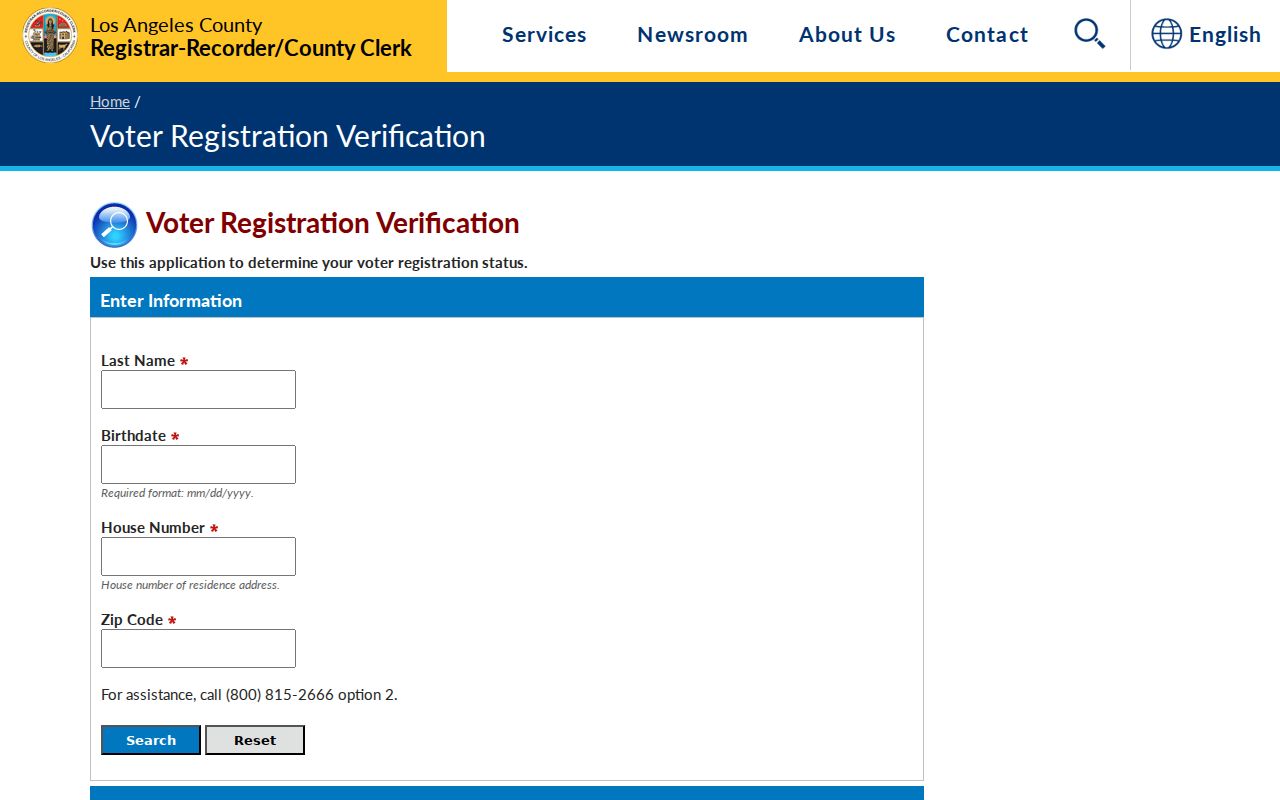
The four-field design keeps the form useful for personal verification while limiting the value of a street-wide name sweep.
Glendale Court Records by Case or Name
Los Angeles Superior Court’s Find a Case route accepts a case number for public case information, a calendar lookup, or a separate party-name search. Name searching covers civil, criminal, family, and probate categories, but it carries a fee under California Rule of Court 2.506 and Government Code §68150(l). Case document images have their own charges, and criminal and family images are not available online.
A result can show the case number, filing context, public party or defendant names, attorneys where public, dates, register-of-actions events, future hearings, disposition entries, and selected civil or small-claims images. Juvenile, sealed, and confidential matters may be missing. The Glendale courthouse at 600 E. Broadway is a fallback for a public-access terminal or clerk help when the online route does not answer the question.
The court fee information gives the image schedule: $1 per page for the first five pages, $0.40 per added page, and a $40 maximum per document. Confirm the live schedule before paying.
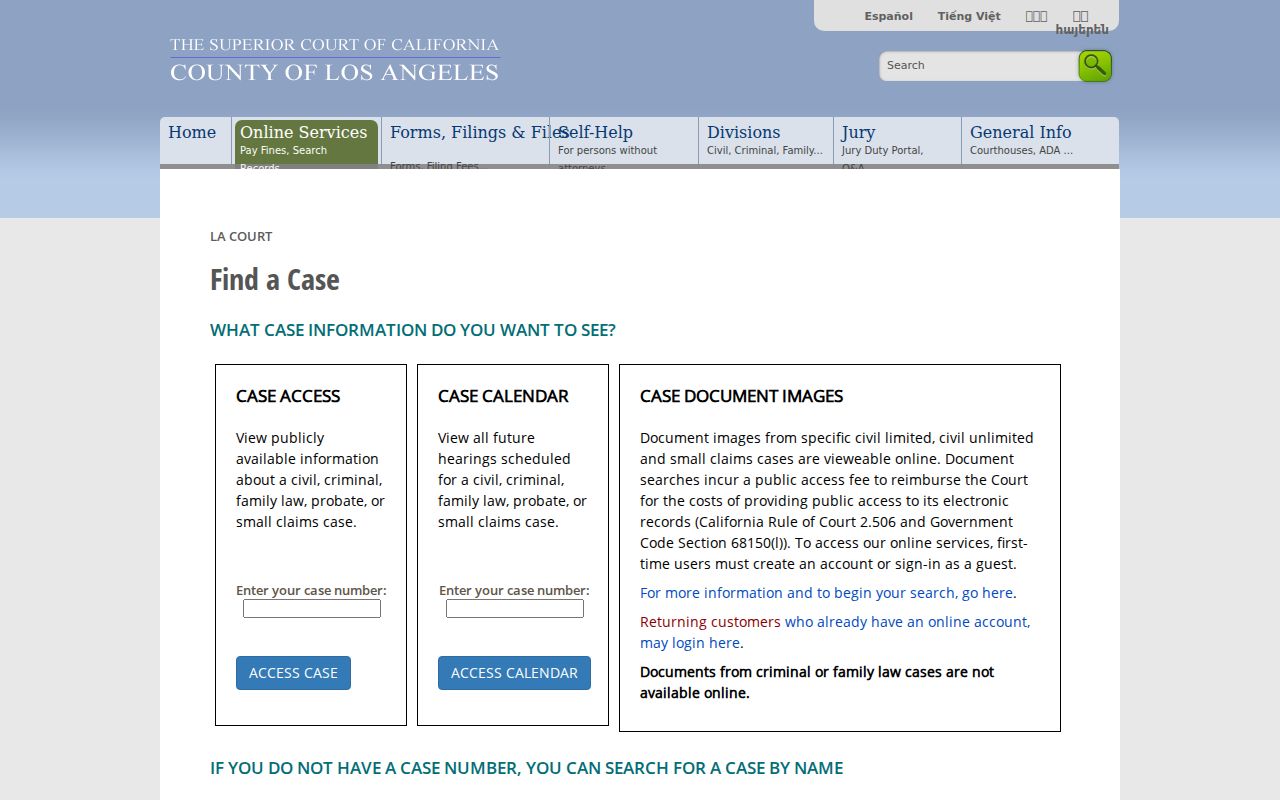
The case search screen is a starting point. Match the courthouse, case number, party role, dates, and a second record before joining a court hit to a Glendale person.
Glendale Vital Records and Copy Rules
Birth, death, marriage, and divorce records answer event questions rather than current-resident questions. Los Angeles County RR/CC is usually the practical custodian for a Glendale event. California Department of Public Health maintains statewide vital records beginning in July 1905, while divorce files remain Superior Court matters. The county’s pages contain coverage discrepancies, including one service statement reaching births to 1866 and another viewing statement using 1877, so the desired series must be confirmed with the custodian.
California uses authorized and informational certified copies. County fees in the research are $34 for birth, $26 for death, and $19 for a public marriage copy. Confidential marriage records are restricted under Family Code §511. Health and Safety Code §§103525-103526 govern authorized eligibility and informational copies. Public inspection requires an application, enough identifying information, and a record-specific search; random browsing is not allowed. Mail requests for some birth classes can take up to 20 business days, and fees are nonrefundable even when a No Record Statement is issued.
- Birth: RR/CC or CDPH, with authorized or informational copy rules.
- Death: RR/CC or CDPH, with eligibility and certified-copy law.
- Public marriage: county search and copy route after identifying both parties and an approximate date.
- Confidential marriage: issuing county, with parties or a court order and good cause under Family Code §511.
- Divorce: Superior Court, because a state certificate is not the full judgment.
The county birth-copy instructions set the application, appointment, and identification steps for the in-person route.
The county’s vital-record viewing rules make the distinction clear: an index or certificate can establish an event, but it is not an unlimited name-browsing tool.
Glendale Permits as Address Evidence
Glendale’s current public permit route is the Tyler EnerGov search at Glendale Permits. The older Property Information Portal and city request form describe coverage from 2005 forward, with a warning that completed cases are not all present. A permit can connect an address to an owner, applicant, architect, contractor, project, or alteration date. It does not prove that the named person lived there.
When the online result is thin, use the permit-record request form. It asks for the requestor’s name, address, email, phone, date, signature, and up to six requested addresses. The form may be sent to PSCApplication@glendaleca.gov or faxed to (818) 548-3215. Building and Safety is listed at 633 E. Broadway, Room 101, with a ten-day allowance. City records requests use the CPRA route, but the ten-day notice is a determination window, not a promise that every file will be produced by then.
Permit chronology is strongest when paired with an AIN, deed, historic directory, or Sanborn map. Missing permit evidence should lead to another source, not a conclusion that a building or household was absent.
Glendale’s Older Resident Directory Shelf
Glendale’s historical residents directory shelf is anchored by the Glendale History Room at Central Library, 222 E. Harvard Street, on the second floor. Access is by appointment. No Glendale library card is required. The room holds reference-only books, photographs, pamphlets, maps, and periodicals; most material is closed stack and requested from staff. Pencils and laptops are allowed, and reproduction needs permission. The History Room information page lists Ancestry Library, ProQuest Los Angeles Times 1881-1993, LA Daily News 1995-current, GLAC Oral History, Super Newsstand, Reference Solutions, and Ward’s Business Directory.
Digitized Glendale directories include 1908, 1909, 1911-12, 1913-14, 1915-16, 1917, 1919, 1922, 1923, 1925-29, 1935, 1937-38, 1941-45, 1947-49, 1958, 1971, and 1989-90, with gaps. Publishers include Occidental Directory Co., Southern California Directory Co., A.T. Cowan, Western Directory Co., Glendale Directory Co., R.L. Polk & Co., and Arnold Advertising Inc. The full collection has more than the scans. The detailed shelf method belongs on the Glendale city directories page, but the home residents directory should always point historical questions toward that local room.
Research habit. Treat each directory as a dated snapshot. Pair its address and occupation clues with a deed, permit, census schedule, obituary, or Sanborn sheet before drawing a long-term conclusion.
Glendale Privacy and Honest Dead Ends
Some missing names are a feature of the law, not a failed search. California’s Safe at Home program supplies substitute mailing addresses for eligible survivors and protected people. Voter confidentiality, DMV rules, utility-account privacy, sealed court files, adoption records, juvenile material, and protected vital records can all interrupt a Glendale residents directory trail. The Attorney General’s consumer-privacy guidance also covers rights to know, delete, correct, and opt out of sale or sharing for covered data, while the Delete Act’s current operation should be checked before promising a one-click result.
Use public records for family history, estate work, reconnection, civic research, and personal record checking. Confirm a suspicious deed or solicitation with RR/CC. Correct a wrong index at its custodian. Never publish an address to help someone threaten, follow, or expose another person. A lawful search accepts an honest dead end when the record was designed to stay private.
Lawful use. Glendale records may support personal research, but public availability is not permission to stalk, harass, intimidate, or harm anyone. Stop and contact the proper custodian when privacy rules close a trail.