
How Glendale Residents Are Found
Match your first clue to the right record keeper and a Glendale residents directory search goes smoothly. Start with a street or parcel number at the Los Angeles County Assessor. Use the Glendale map layers too. Deeds are different. The Registrar-Recorder/County Clerk indexes by party name and document detail, since no address or AIN deed index exists there. Your own voter registration can be confirmed through the county form. Court cases open best with a case number or a paid name-search route.
Older Glendale residents surface in city directories, reverse address books, and census schedules. Newspapers, permits, and the Glendale History Room help too. Each record captures a date, a role, an address, or a household snapshot. None lists every person at a place. Occupants go missing, and owners often live elsewhere. Tag each fact for what it is: ownership, registration, business role, listed residence, or historical association. That discipline keeps a resident lookup honest.
- Write down the exact name, address, middle initial, former spelling, or year that starts the search.
- Use the Los Angeles County Assessor Portal for an address or AIN and save the parcel details.
- Match the clue to the LA County voter verification, court, license, business, or vital-record route that accepts it.
- Use the county recorder, city permit archive, or library shelf when a web index stops.
- Compare two independent records before treating a name and Glendale address as the same person.
Where Glendale Resident Records Sit
The Glendale residents directory sits across city, county, and state desks. Glendale City Hall holds municipal permits, planning cases, council material, maps, police-request routing, and the city's own public-records process. Birth and death certificates, marriage copies, fictitious-name filings, county business filings, and real-property ownership questions all route to Los Angeles County instead. For an existing city record, the Glendale City Clerk request page is the right start. It will not produce a fresh resident list.
No single county office holds everything. The Registrar-Recorder/County Clerk keeps recorded instruments, vital and marriage records, fictitious business names, and election services. The Assessor keeps parcel and value data. Superior Court keeps case files. Remember the separation. A permit applicant is not automatically an owner, and a deed party is not automatically an occupant.
Los Angeles County RR/CC
12400 Imperial Highway
Norwalk, CA 90650
(800) 201-8999
Los Angeles County Assessor
Public web search: AIN or address
Owner data: office or data sales
Owner-name search is offline
Los Angeles County Assessor Portal
LA County Elections
12400 Imperial Highway
Norwalk, CA 90650
(800) 815-2666 option 2
LA County Voter Registration Verification
Glendale Names and Addresses Take Different Paths
Names and addresses travel different paths in Glendale. A name helps at Superior Court, the Secretary of State, the Department of Consumer Affairs, the State Controller, or a library. An address works best at the Assessor, the GIS viewer, the permit portal, the USPS lookup, and historical reverse directories. One person may show up as a deed grantee, a licensee, a business agent, and a directory resident all at once. Each label answers a different question.
Begin a current Glendale residents directory search with the narrowest fact you hold. A case number beats a common name. An AIN is more stable than a street string. A directory year beats a vague claim that someone once lived in the city. Record the source date and the field used. Then test the match against a second office before you trust it.
- Name and event: begin with a court, vital, license, or business index for a party, event, credential, or filing link, not a current-residence claim.
- Street address: use the Assessor, GIS, and permits for parcel, map, work, and party clues, not every occupant.
- Old address and year: use the History Room, reverse directory, or census for a dated household snapshot, not continuous residence.
- AIN or deed party: use the RR/CC recorder for a recorded transfer and legal description, not proof of who occupied the property.
- Own name and address fields: use LA County voter verification for the requester’s registration status, not a stranger’s status.
Why Glendale’s Assessor Search Starts With an Address
The public Assessor Portal takes an AIN or a situs address. It will not reverse-search an owner name on the web. Official help says ownership information is available at Assessor offices or through Property Data Sales. That design is a key Glendale residents directory fact. A name-first search often fails at the first click. The parcel itself is still easy to find.
From the result, capture the AIN, property address, legal description or map reference, property type, assessed land and improvement values, tax-rate area, transfer indicators, and building details when shown. The situs is the physical parcel. A mailing address is where assessment or tax mail goes. Neither field is a household roster. Corner lots, multiunit buildings, commercial sites, and new parcels may carry an enrolled address that differs from the typed address. Check the county map and nearby cross streets as part of the search.
| Assessor field or control | How it works in Glendale |
|---|---|
| Search by AIN or Address | Required text or autocomplete route for a parcel locator. |
| Basic Search | Standard address and AIN route. |
| Legal Search | Legal-description-oriented route. |
| Map Search | Pan, zoom, and click parcel shapes when the typed address misses. |
| Assessor Internet | Assessment detail view after the parcel is located. |
Glendale parcel records carry one quirk worth knowing early. The Assessor's indicated sales price is not always a literal price. A figure like $450,004 can be a transfer-tax signal whose leading digits were copied over, meaning no one actually paid four hundred fifty thousand and four dollars for the property. Treat that field as a lead, not a fact. Before relying on it, confirm the recorded instrument through the Recorder's own records, since the deed is the document that settles what really changed hands.
From a Glendale Address to an AIN
Parcel research gets steadier once a street line becomes an Assessor Identification Number. Glendale's city map catalog and the LA County Assessor map layer in zoning, parcel outlines, historic parcels, neighborhood zones, streets, ZIP layers, and city-boundary context. Those layers show where land sits. They do not show every person near it. A workable address trail runs in a simple chain: address, then map parcel, then AIN, then parcel facts, then an authorized owner channel, then the deed party, then permits and historical directories. Record one AIN per condominium unit or adjacent parcel. If a street number fails, try nearby cross streets. The map, the legal description, or an older name from a directory or Sanborn sheet can also break the impasse. Before assuming a modern Glendale city line existed in an earlier year, check the Glendale City Maps catalog for historic parcel and neighborhood context.
- AIN
- The county parcel number used to connect an address to assessment records.
- Situs address
- The physical location of the parcel, distinct from a tax or owner mailing address.
- Legal description
- The tract, lot, block, or other title description that can survive a street-name change.
- Criss-cross directory
- An address-first directory section that turns a street number into a listed name for a particular year.
The Glendale Recorder’s Party-First Trail
The Registrar-Recorder/County Clerk will not pull a Glendale deed by street address or AIN. A request needs a document number. Otherwise it needs a recorded party name with the year and document title. The cited search fee is $0.50 per name per year. Copy schedules run $6 for the first page and $3 for each additional page. Real-estate copies are commonly available at branches for 1982 forward. Norwalk holds the older index and deed material. Start with the AIN and an owner identity from an authorized county channel. An existing deed also works. Search that person as a grantee. That search finds the acquisition instrument. Write down the grantor, the recording date, and the instrument number. Also note the document type and the legal description. Then search the grantor as an earlier grantee. Repeat only while the legal description and parcel lineage still match. The full historical route happens in person. Norwalk records from 1851 through 1957 are reviewed downstairs. Records from 1958 forward sit upstairs by appointment. The branch cutoff is no reason to stop.
- Grantor and grantee: the transfer parties in their recorded roles.
- Document number and recording date: the instrument locator and place in the chain.
- Document title: the difference between a deed, lien, release, reconveyance, or another instrument.
- Legal description: a check that the party record belongs to the same land.
- Copy or image: paid instrument text subject to redactions and access restrictions.
Note: The Recorder's no-address rule means a parcel clue must become a party or document clue before any Glendale deed search can begin.
Current Glendale Resident Sources
None of the current sources works as a true Glendale residents directory on its own. The Assessor connects a parcel to an owner through an AIN. Voter status checks confirm one registration at a time. A court docket names parties, and a permit names an applicant or work site. Business filings can reveal a public role. Together they offer real lookups. But no office publishes a citywide roster of everyone living in Glendale.
| Source | People or places represented | Keeper | Access |
|---|---|---|---|
| Assessor parcel card | Parcel, values, owner channel, situs | Los Angeles County Assessor | Free address or AIN web search; owner name offline |
| Recorded instrument | Deed parties, liens, releases, legal descriptions | LA County RR/CC | Named or document request; paid copies |
| Voter verification | Requester’s registration status | LA County Elections | Free self-check with four fields |
| Permit or planning case | Address, work, applicant, contractor, dates | City of Glendale | EnerGov search; request omitted files |
| Historical directory | Listed occupant, occupation, address, household clues | Glendale History Room | Appointment and digitized scans |
A Glendale resident lookup works best when you already hold a parcel. You want the person tied to it. Flip the approach for a whole street. Map each parcel in turn. A name hit alone never proves anyone currently lives at an address. Association pages and lists of public officers add civic color to a street directory. No authoritative citywide membership roster exists for Glendale. Treat those lists as leads, not as a residents directory of record.
Matching a Glendale Person Across Records
Glendale holds roughly 196,500 people. Common names repeat fast here. Matching the same first and last name is only a start, so capture spelling, middle initial, suffix, former names, occupation, approximate age, event dates, party role, and the address field. Then line up at least two official record sets before you trust the match. A court case number next to a parcel clue beats any name-only search. Remember that a business agent's address marks a service location, not a home.
- Deed plus Assessor: compare the AIN, party, legal description, and recording date, while keeping ownership separate from occupancy.
- Court plus another record: compare the case number, party role, courthouse, and dates, remembering that confidential matters may be absent.
- Directory plus census: compare address, spouse, occupation, and household year, treating each source as a dated snapshot.
- License or business filing: compare name, status, role, and filing address, while treating a service address as distinct from residence.
| Source type | Strength | Limit |
|---|---|---|
| Official custodian records | Defined fields, dates, and a source office that can verify or correct them | Each record set answers a narrow question |
| Counter, mail, or paid copy route | Reaches records that are not exposed in a public web index | Eligibility, fees, appointments, and search limits apply |
| Commercial people-finder category | May offer a lead assembled from mixed public and marketing data | Can be stale, merge names, and lacks custodian authority |
Glendale Voter Registration Verification
The LA County voter verification form is deliberately narrow. It asks only for a last name, birthdate, house number, and ZIP code. A match comes back as a self-check. It is tied to those exact fields and current system updates. It is not a browse-by-street Glendale residents directory. California Elections Code §§2180-2194 restrict how voter files may be used. The full or selected voter file is a separate controlled product. Its county order form requires requester details, geographic scope, delivery type, and a permitted-use declaration. Commercial use is forbidden under the cited rules. Confidential voters and Safe at Home participants need special handling. Calling a neighbor-roster request a public-records request does not make it lawful. The verification screen's own fields block casual street enumeration.
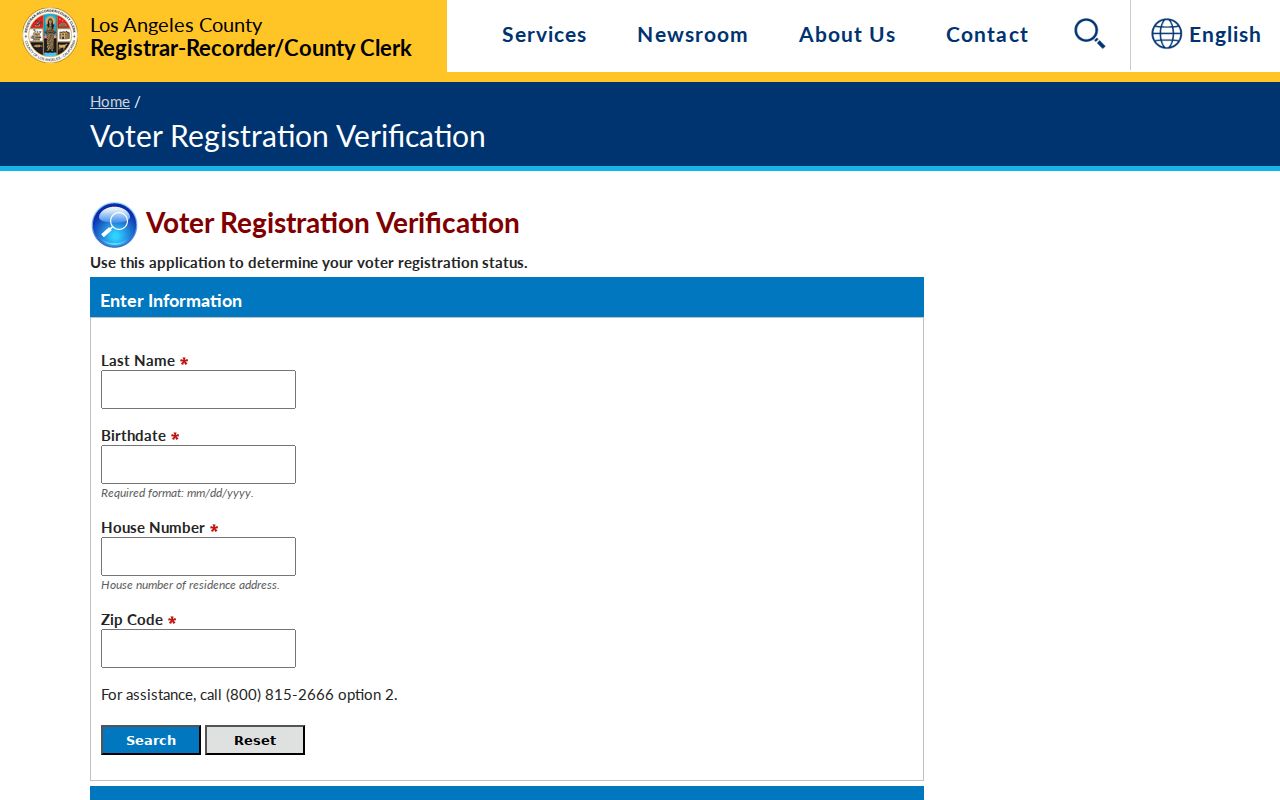
The lookup form asks for just four fields. That design suits a Glendale resident checking a personal voter registration record, yet it blunts any attempt to sweep a whole street for names through the residents directory.
Glendale Court Records by Case or Name
A case number opens the fastest door. Los Angeles Superior Court's Find a Case tool accepts a number for public case details, a calendar check, or a separate party-name search. Name searching spans civil, criminal, family, and probate categories. It costs money, though, under California Rule of Court 2.506 and Government Code §68150(l). Document images carry separate charges, and criminal and family images never appear online.
A single result can include the case number, filing context, public party or defendant names, attorneys where public, dates, register-of-actions events, upcoming hearings, disposition entries, and selected civil or small-claims images. Juvenile, sealed, and confidential matters may be absent. When the online route stalls, the Glendale courthouse at 600 E. Broadway offers a public-access terminal and clerk help.
The court fee information posts the image schedule. It runs $1 per page for the first five pages, $0.40 for each added page, and $40 per document at most. Confirm the live schedule before paying.
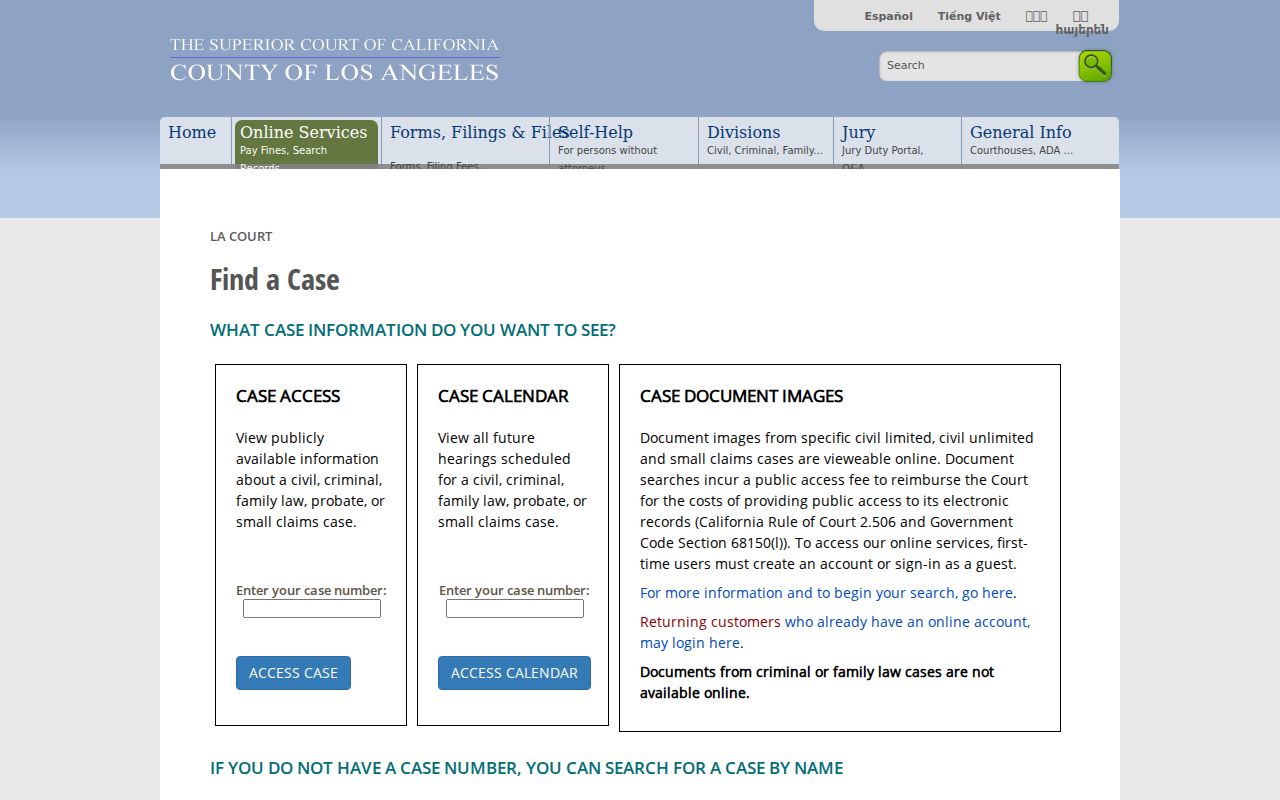
Treat the case search screen as a starting point, never a verdict. Match the courthouse, case number, party role, and dates, and find a second record before tying any court hit to a Glendale resident.
Glendale Vital Records and Copy Rules
Vital records answer event questions, not current-resident questions. For a Glendale birth, death, marriage, or divorce, Los Angeles County RR/CC is usually the practical custodian. The California Department of Public Health keeps statewide vital records from July 1905 forward. Divorce files stay with the Superior Court. The county's own pages disagree on coverage: one service statement reaches births back to 1866, while a viewing statement says 1877. Confirm the series you need with the custodian.
California splits certified copies into authorized and informational versions. County fees run $34 for birth, $26 for death, and $19 for a public marriage copy. Confidential marriage records stay restricted under Family Code §511. Health and Safety Code §§103525-103526 govern who qualifies. Public inspection requires an application, enough identifying detail, and a record-specific search; random browsing is off the table. Some mailed birth requests take up to 20 business days. Fees are nonrefundable, even when the answer is a No Record Statement.
- Birth: RR/CC or CDPH, with authorized or informational copy rules.
- Death: RR/CC or CDPH, with eligibility and certified-copy law.
- Public marriage: county search and copy route after identifying both parties and an approximate date.
- Confidential marriage: issuing county, with parties or a court order and good cause under Family Code §511.
- Divorce: Superior Court, because a state certificate is not the full judgment.
The county birth-copy instructions lay out the application, appointment, and identification steps for an in-person visit. The county's vital-record viewing rules draw the line plainly. An index or certificate can establish an event, but it is not an unlimited name-browsing tool.
Glendale Permits as Address Evidence
Glendale's current public permit route is the Tyler EnerGov search at Glendale Permits. The older Property Information Portal and the city request form describe coverage from 2005 forward. Completed cases are not all present, the city warns. A permit can tie an address to an owner. It can also name an applicant, architect, contractor, project, or alteration date. It cannot prove the named person lived there.
Thin results call for the permit-record request form. It asks for the requestor's name, address, email, phone, date, and signature. The form covers up to six addresses. Send it to PSCApplication@glendaleca.gov or fax it to (818) 548-3215. Building and Safety sits at 633 E. Broadway, Room 101, with a ten-day allowance. City records requests run through the CPRA route. The ten-day notice is a determination window, not a promise that every file arrives by then.
Permit chronology works best beside an AIN, deed, historic directory, or Sanborn map. Missing permit evidence should push you toward another source. It should not push you toward a conclusion that a building or household was absent.
Glendale’s Older Resident Directory Shelf
The Glendale History Room anchors the city's historical residents directory shelf. It sits on the second floor of Central Library at 222 E. Harvard Street. Visits run by appointment. No Glendale library card is needed. The room holds reference-only books, photographs, pamphlets, maps, and periodicals, most of it closed stack and requested from staff. Pencils and laptops are fine; reproduction takes permission. The History Room information page lists Ancestry Library, ProQuest Los Angeles Times 1881-1993, LA Daily News 1995-current, GLAC Oral History, Super Newsstand, Reference Solutions, and Ward's Business Directory.
Digitized Glendale directories cover 1908, 1909, 1911-12, 1913-14, 1915-16, 1917, 1919, 1922, 1923, 1925-29, 1935, 1937-38, 1941-45, 1947-49, 1958, 1971, and 1989-90, with gaps. Publishers range from Occidental Directory Co., Southern California Directory Co., A.T. Cowan, and Western Directory Co. to Glendale Directory Co., R.L. Polk & Co., and Arnold Advertising Inc. The full collection reaches beyond the scans. The detailed shelf method lives on the Glendale city directories page. This home residents directory still points historical questions toward that local room first.
Research habit. Treat each directory as a dated snapshot. Pair its address and occupation clues with a deed, permit, census schedule, obituary, or Sanborn sheet before drawing a long-term conclusion.
Glendale Privacy and Honest Dead Ends
A blank result is not always a failure. Sometimes the law itself pulled the name out of view. California's Safe at Home program gives eligible survivors and protected people a substitute mailing address. So they never surface in a Glendale residents directory. Voter confidentiality, DMV rules, utility-account privacy, sealed court files, adoption records, juvenile material, and protected vital records can each quietly cut off a resident lookup trail.
Privacy law adds another layer. The Attorney General's consumer-privacy guidance describes rights to know, delete, correct, and opt out. It also covers the sale or sharing of covered data. The Delete Act promises simplification. But check how it currently operates before counting on a one-click removal.
Used honestly, public records serve family history, estate work, reconnection, civic research, and checking your own file. Confirm a suspicious deed or solicitation with the RR/CC. A wrong index gets corrected at its custodian. Never publish an address to help someone threaten, follow, or expose another person. When a record was designed to stay private, a lawful search simply accepts the dead end.
Lawful use. Glendale records may support personal research, but public availability is not permission to stalk, harass, intimidate, or harm anyone. Stop and contact the proper custodian when privacy rules close a trail.