
Glendale Directory Years and Shelves
Glendale's historical directory shelf is a set of dated snapshots, not one unbroken resident roll. The digitized list has important gaps, while physical holdings extend beyond the editions available online. Publisher changes also matter because each imprint can set its own abbreviations, address order, and household marks. The table keeps the documented years and named publishers together without guessing at a publisher for an edition the local research does not identify.
| Collection | Years | Publisher | Where Held | Access |
|---|---|---|---|---|
| Digitized Glendale directories | 1908; 1909; 1911-12; 1913-14; 1915-16; 1917; 1919; 1922; 1923; 1925-29; 1935; 1937-38; 1941-45; 1947-49; 1958; 1971; 1989-90 | Occidental Directory Co. (1908); Southern California Directory Co. (1911-12); A.T. Cowan (1919); Western Directory Co. (1923); Glendale Directory Co. (1935 and 1949 sampled); R.L. Polk & Co. (1971); Arnold Advertising Inc. (1989-90) | Glendale Historical Society index; Internet Archive and California Revealed scans supplied by Glendale Library, Arts & Culture | Free scans; physical holdings extend beyond the digitized set |
| Telephone and reverse directories | Telephone directories 1908-1977; reverse sections begin in the teens, with 1917, 1919, and 1922 documented | Varies by edition | Glendale History Room | Appointment; reference-only and often closed-stack |
| Physical local-history directory holdings | Beyond the online year list | Varies by edition | Central Library History Room, with related material at Montrose Library and Brand Library | Staff retrieval, pencil or laptop notes, reproduction permission |
Years such as 1941-45 and 1947-49 are grouped in the digitized inventory, so a researcher should confirm the exact scan inside the edition list. A missing year is not proof that no directory was printed. It means the accessible run is not continuous, and a staff-assisted shelf check may be needed.
Note: A digitized edition is a free research lead, while the History Room remains the route to physical volumes and local context beyond the scans.
Glendale City Directory Shelf Access
The Glendale History Room is on the second floor of Central Library at 222 E. Harvard Street, Glendale, CA 91205. Access is by appointment, but a Glendale library card is not required. Contact glendalehistoryroom@glendaleca.gov or (818) 548-2037 before traveling, especially when a specific year or address section is needed. The official Glendale History Room page is the current access point.
Holdings are reference-only. Books, photographs, pamphlets, maps, and periodicals may be cataloged even when they are not on an open shelf. Most material is closed-stack and must be requested from staff. Researchers sign the register. Pencils and laptops are allowed, and reproduction requires permission. Those rules make a short appointment useful: arrive with a name, a likely year, a street spelling, and a list of alternate forms.
The city's Glendale Historical Research Guide broadens the search beyond the directory shelf. Its house-and-people method combines land, building, associated people and events, then checks permits, assessor records, maps, newspapers, photographs, census schedules, and local histories. A directory entry is strongest when it is compared with at least one of those independent sources.
For the land side of that history, the Los Angeles County Registrar-Recorder/County Clerk keeps recorded instruments and the legal chain. Its index is not address-searchable online, so the History Room and county counter serve different parts of the same Glendale house question.
Find Glendale City Directories Online
The Glendale Historical Society digitized directory list gathers the online editions and points researchers toward the available scans. The project includes 28 digitized editions in the documented inventory, with scans supplied through Glendale Library, Arts & Culture, Internet Archive, or California Revealed. The list is the best first check for a year before asking History Room staff to retrieve a physical volume.
The online image below is useful for a different reason than a bare link. It shows the collection's edition-centered organization, where the year and scan lead matter as much as the surname being searched.
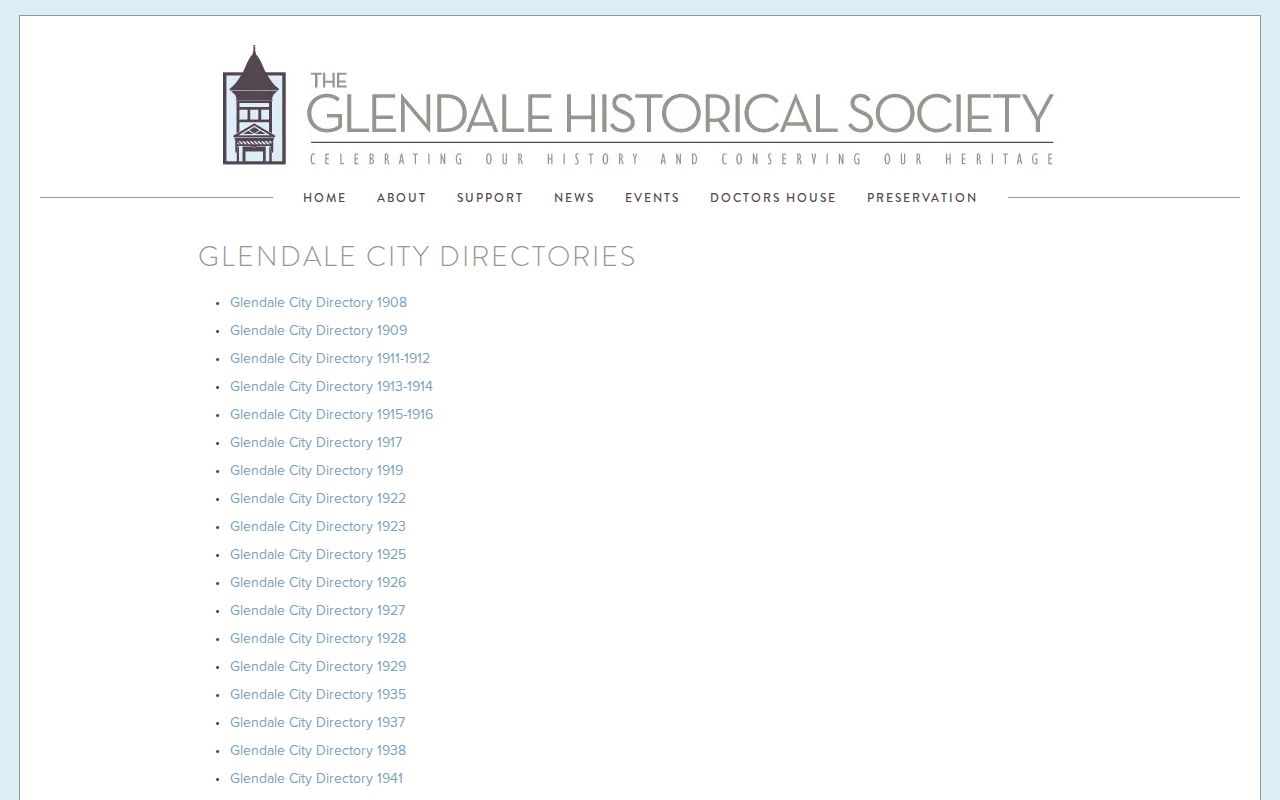
The capture connects the digital shelf to an actual source. Check the scan itself, not just an OCR hit, because street numbers, fractions, initials, and line breaks can be misread.
Digitization does not make the run complete. Physical holdings may contain years or local materials that are absent from the online list, and some scans may be grouped into multi-year ranges. Record the edition title, publisher, page, and image link so another researcher can reproduce the finding.
Read a Glendale City Directory
A Glendale city directory entry is a compact set of clues. The 1923 Western Directory Co. volume shows the pattern clearly: a surname and given name, a spouse in parentheses when supplied, an occupation or business affiliation, and a home or business address. Some entries use widow notation or a residence marker. An address-order section may list several people or businesses at one number, so the alphabetical and reverse halves should be read together.
| Name | Surname, given name, or initial; a spouse may appear in parentheses. |
|---|---|
| Occupation | Business or trade information, sometimes with a separate business address. |
| Address | House number and street, with residence or business markers defined by that edition. |
| Owner/renter mark | Some runs use a mark for status; record it only when the volume's key defines it. |
| Widow notation | A notation such as “wid Charles” can connect a household to a spouse or death record. |
| Edition identity | Year, publisher, page, and abbreviation key establish the meaning of every symbol. |
- Criss-cross directory
- The address-order half of a volume. It starts with a street and number, then lists the names or businesses printed for that location.
- Householder index
- An address-focused guide to household heads or principal listings. It may not include every person connected to the address.
- Abbreviation key
- The edition's legend for residence, business, spouse, widow, occupation, or status marks. Read it before interpreting an entry.
- Index versus image
- An OCR or name index is a pointer. The page image is the authority for spelling, line breaks, fractions, and nearby entries.
When a mark is unclear, cite the page and preserve the original spelling before normalizing a name. That small habit helps prevent two different Glendale households from being merged.
Glendale Reverse Directory Clues
Address-first work is the special strength of a reverse directory. Start at a street number, scan the nearby range, and list every printed name before moving to the alphabetical section. Compare occupation, spouse, and business information. If a street was renamed or renumbered, use the edition's map notes, the 1887 plat, or a Sanborn sheet to test whether the old and new entries refer to the same land.
Glendale's documented reverse use in 1917, 1919, and 1922 makes those volumes valuable bridges. The 1908 directory lacks full street numbers, so the telephone run is not equally useful for every address. A person can disappear because of a move, death, a missing year, a change in spelling, or a publisher's decision not to print the person. Treat the gap as a research question.
Address sections also show why a historical directory is not a modern resident database. Listings reflect the publisher's collection practice and the information supplied for that edition. Use the resulting name as a lead for a deed, census, obituary, permit, or local newspaper check.
Note: Read the reverse section and its key before relying on an address entry, because each publisher's marks and coverage can differ.
Trace a Glendale Household by Year
Household tracing works when one known entry becomes a dated sequence. Choose an exact spelling, record the address and occupation, and keep the source page with the note. Then move through the available editions rather than treating a single appearance as a complete life story.
- Choose a starting year. Find the name in the alphabetical section and record the spouse, occupation, residence marker, and address.
- Check the address section. Use the criss-cross or householder section when that edition has one, and compare nearby names without assuming they share a household.
- Move forward and backward. Track each address change, spelling shift, spouse notation, and occupation change across the next available years.
- Pair the gaps. Compare the directory snapshots with the 1920, 1930, 1940, and 1950 federal census schedules, then verify major changes in newspapers, permits, or maps.
- Test the ending. Search an obituary or probate record when the person disappears, and keep a separate note when the result points to a different household.
A disappearing entry is not a conclusion. A move can be separated from a death by a later directory, an obituary, a probate petition, or a new address in a census schedule. The best trail names the uncertainty and says which source may resolve it.
A Glendale Directory Gap Explained
An official Glendale survey demonstrates the value of combining records. Its 1917 material supplied no address for one example, while the 1923 Western Directory Co. entry identified Albert M. Draper as a refiner residing at 534 N. Kenwood. A 1919 Sanborn map adds a building footprint between those points in time. The sequence does not prove every detail of the household, but it shows how a missing line can be tested rather than treated as absence.
The 1923 Glendale city directory scan provides the page-level example, including the alphabetical material and the Householders' Guide. The image below is a direct view of that local directory source.
The scan makes the method concrete: verify the printed address, inspect the surrounding entries, and note the publisher before comparing it with a map or another year.
The Library of Congress 1919 Glendale Sanborn atlas contains 45 sheets. It can confirm a structure and its use at a point in time, while the city's historic-resource register can point toward a property-history survey. Maps and directories answer different questions, so keep both citations.
Pair Glendale Directories With Census
City directories and the federal census overlap without duplicating one another. A directory can appear in many years and may include occupation, business, spouse, and address details. A census is an enumeration snapshot with household composition and other fields for its specific date. Pairing the two helps test a move or a household change between decades.
The 1950 federal census is public under the 72-year rule, making it a useful partner for the later printed Glendale city directory years. Compare a known directory address with the 1920, 1930, 1940, or 1950 schedule, then check whether names, ages, relationships, and street forms fit. Do not force a match when a common name has no supporting address or family clue.
Newspapers, photographs, oral histories, permits, and Sanborn maps can fill a gap between the dated snapshots. A census can establish a household at enumeration time, while a directory may show a public listing before or after that date. The differences are evidence, not errors.
Glendale's Other Local Collections
Directory research becomes richer when the local library network and community collections are used together. Montrose Library adds Montrose and Crescenta Valley history, which matters when postal geography and city limits do not line up. Brand Library preserves Leslie C. Brand, El Miradero, and art-center materials. The Central Library History Room's listed databases include Ancestry Library, ProQuest Los Angeles Times 1881-1993, LA Daily News 1995-current, GLAC Oral History, Super Newsstand, Reference Solutions, and Ward's Business Directory.
Montrose Library
Local history for Montrose and the Crescenta Valley, useful when a directory address falls near a postal or municipal edge.
Brand Library
Brand family, El Miradero, and art-center materials that add named people, places, and community context.
TELL ME Oral History
“TELL ME: Stories of Migration to Glendale” preserves volunteered migration narratives supported by California Humanities and California State Library grants.
The Glendale Historical Society supplies the digitized directory list, while historic-resource surveys can contain permits, directory citations, Sanborn observations, prior owners, occupations, and construction history for an individual building. For modern address-keyed parcel work, the Glendale street directory workflow keeps the map and records chain separate from the historical shelf.
Glendale City Directory Timeline
Dates help explain why the collection changes shape over time. The timeline below places the documented editions beside the local street and map history that affects interpretation.
- 1887: Glendale's town plat was recorded, creating an early land framework for later address research.
- 1908: The digitized list begins with an Occidental Directory Co. edition; full street numbers are not present throughout the early run.
- 1917-1919: Reverse use is documented in 1917, the Tropico annexation brings major 1918 street-name and numbering shifts, and A.T. Cowan publishes the 1919 edition.
- 1922-1923: A documented reverse section appears in 1922, followed by the Western Directory Co. volume and the Albert M. Draper example in 1923.
- 1925-1929: The digitized inventory groups this run as a multi-year set, so each scan should be checked for its exact edition.
- 1935-1949: Glendale Directory Co. editions are sampled for 1935 and 1949, with 1937-38 and 1941-45 also listed in the digital run.
- 1958-1989: Later digitized points include 1958, 1971 from R.L. Polk & Co., and 1989-90 from Arnold Advertising Inc.
The gaps make source comparison essential. A name in one Glendale city directory can be a strong lead, but the dated address, publisher key, map, census, and independent record should carry the conclusion together.